Saturday, August 8, 2009

The Military will save us, right?


The NY Times published an article today titled, "Climate Change Seen as Threat to U.S. Security."

Through statements from people in the military, the article tells us that more extreme weather patterns will create unlivable conditions in the already poor parts of the world, causing conflict. Because of the one dimensional quotes, the reader is left to wonder if the U.S. should provide aid with our military, or protect our right to resources and borders.   Forget that our current levels of resource consumption are causing the problems in the first place, we need to hang to our lifestyles with every bullet we've got! 

They published this on a Saturday.  Nobody reads the paper on Saturday!  As Richard Heinberg says in Powerdown, articles about the impending crises ahead caused by systematic fossil fuel consumption and resource depletion appear periodically in major news sources but do not remain part of a news cycle and do not appear often enough to become regularly discussed issues.  It is too frightening, too complex, too destructive to the way we have come to understand our world and our lifestyles.  It is also too long term.  We do not base our actions on their consequences decades from now...but we can if we try.

Friday, August 7, 2009

Eat it, Monsanto!

In early May, I planted some seeds in containers on our balcony from produce I bought at the supermarket .  I was fearful that these industrial hybrid seeds probably owned by DuPont or Monsanto would either grow surveillance cameras and eventually explode, or just not fruit.

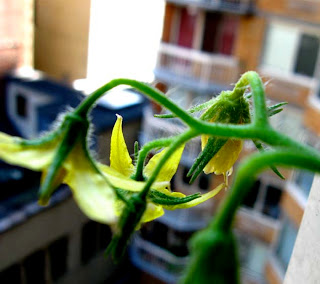
But my illegal tomatoes have responded well to my love and attention. 


And my pepper plants are flowering too.  Seems like they take a little bit longer than tomatoes.


In other balcony news, I have to give my compost away today!  Despite the anaerobic environment of the buckets, I managed to maintain a little bit of integrity with the material. The left bin has been resting for about 2 months, while the right bin our active one.


I am moving to Seattle in a week, so I am giving my compost to the Lower East Side Ecology Center.  They set up a compost collection booth at the Union Square Farmer's Market 4 times a week.  My urban experiment is over, but I found an organization in Seattle that offers workshops in urban composting, container gardening, urban chicken husbandry, and other great topics.  Most of the workshops are free!  

Wednesday, August 5, 2009

From Magnificent Maize to Clever Corn

Corn has been food science since its invention in southern Mexico more than 6,000 years ago.  All the other major cereals--wheat, rice, millet, and barley--had wild ancestors or even have wild analogues today, and all of them can propagate themselves if left untended.  Corn, called maize in most countries because of its species name Zea mays, cannot reproduce without human intervention.  This shows that in order to create the corn species, it required some hybridization from existing wild species.  Thus, it is an invention, not a domestication.

Today, corn is the world's most important crop in terms of annual harvest weight.  It has been put on a pedestal by the Green Revolution following WWII, not to be confused with the amorphous, nameless, grassroots movement happening worldwide today.  The Green Revolution transformed agriculture worldwide to depend on monocultures of hybrid seeds created in research laboratories and inputs of increasing amounts of chemical fertilizers, pesticides, and herbicides.  These transformations mechanized agriculture, which increased yields and provided cheap food all over the world.  But the system was powered by cheap fossil fuels and took the knowledge and resources of farming out of the hands of farmers and centralized them in the hands of corporations or universities largely funded by corporations. 

The Green Revolution made traditional agricultural practices evolved over hundreds or thousands of years obsolete because the hybrids and fertilizers could boost yields to create unheard of amounts of food per acre.  In Mexico, the Green Revolution almost entirely eliminated the ancient farming practice called the milpa, which is a field interplanted with corn, beans, squash, avocados, melon, tomatoes, chilis, sweet potato, jicama, amaranth, and mucuna.  Milpas are regarded by scholars in many academic fields as the most intelligent farming in human history.  Here is a passage from 1491 by Charles Mann that describes the milpa. 

"In nature, wild beans and squash often grow in the same field as teosinte, [an extinct, ancient relative of corn possibly used in combination with other species to create corn] the beans using the tall teosinte as a ladder to climb toward the sun; below ground, the beans' nitrogen-fixing roots provide nutrients needed by the teosinte.  The milpa is an elaboration of this natural situation, unlike ordinary farms, which involve single-crop expanses of a sort rarely observed in unplowed landscapes.
Milpa crops are nutritionally and environmentally complementary.  Maize lacks the amino acids lysine and tryptophan, which the body needs to make proteins and niacin; diets with too much maize can lead to protein deficiency and pellagra, a disease caused by lack of niacin. Beans have both lysine and tryptophan, but not the amino acids cysteine and methionin, which are provided by the maize...Squashes, for their part, provide an array of vitamins; avocados, fats." (p. 198)  

The milpa, which has been adopted by Permaculture, also naturally replenishes the soil with the nutrients to continually replant in the same soil.  When interplanted as a guild, each species has certain qualities that take advantage of existing natural systems to provide nutrients to humans permanently, thus Permaculture.  When Europeans arrived to the Americas, there were milpas that grew uninterrupted for thousands of acres year after year.  Government and business powers proved that this holistic approach to farming, nutrition, and land use management was obsolete in a post WWII planet with increasing urbanization, population pressures, and access to cheap fossil fuels.  

Today, just a few massive corporations own all of the hybrid seeds used by farmers today.  The crop that benefited the most from this transformation was corn, especially in America.  American agriculture and food corporations rely on government subsidies and cheap oil to turn corn into thousands of "clever variations" as Michael Pollan puts it in Omnivore's Dilemma.  Most corn is processed into odd forms of feed for cattle, chickens, and pigs.  A large portion is also turned into high fructose corn syrup, glucose, partially hydrogenated oil, and so many other hard to pronounce and frightening variations.  In an average grocery store, more than 95 percent of the products on the shelves contain some form of corn.  

Why corn?  Corn growing and harvesting works well with mechanization, it is easy to store, and it grows well in lots of different soils and a wide range of warm and cool climates.  Thus, it was a source of wealth for America.  We could export and store surpluses.  We could trade it globally for oil at a ratio of 1 to 1 until the early 1970s.  Then America hit peak oil in 1970, OPEC staged an embargo in 1973, and the ratio has shot up ever since, and not in our favor. Current prices are at a ratio of about 14:1.  

So what the hell do we do with an agricultural infrastructure set up for corn?  Turn everything we depend on into some manipulation of the crop.  Now we hear elected officials and spokespeople for Chevron talking about using corn to make ethanol for our cars!  America's corn based foods are responsible for our obesity epidemic.  We are overfed, but undernourished.  According to Food Inc., 1 in 3 children born in the U.S. today will have childhood diabetes, for children of color the epidemic jumps to 1 in 2.  Like Majora Carter says, our current sustainability problems are fundamentally linked to poverty, and thus linked to race.  Although all of us cannot avoid eating products of industrial agriculture, our mobility to opt into a sustainable food system is linked to our wealth, our education, and our skin color.       
There were more than 100 million people living in the Americas before Columbus, far more than lived in Europe, who had consumed corn as the centerpiece of their diet.  However, they did not have United States health, soil, and water issues because they developed the milpa.  In addition, indians cooked corn with lime (the mineral, not the fruit), which unlocked the niacin in the corn to allow the human body to absorb it.  Recognizing the intelligence of traditional practices is a key component of Descent Culture.  Wisdom is held in evolution, in gradual developments implemented in response to natural conditions.  Descent does not promote some false sense of nostalgia to get back to an ancient, "natural" way of life the way the Business-As-Usual ascent culture promotes growth and technology blindly.  Plant a regionally adapted version of a milpa in your garden to work toward sustainable sources of food that can exist after cheap fossil fuels.    

Tuesday, July 28, 2009

The new D.A.R.E program: Just Say No to Chemical Fertilizers

A mindset transformed the way we grow food.  It started in the UK in the nineteenth century when a handful of clever chemists thought they figured out that soil health and thus plant growth could be determined and manipulated with three elements: N, P, K, or nitrogen, phosphorous, and potassium.  Europe started importing vast, I am talking vaaaast, amounts of guano (bat shit) from these magical bat shit mountains on the coast of Peru and Chile.  Most bat shit around the world falls on the ground and its nutrients (its super high in nitrogen) get integrated back into the current ecosystem.  Lame.  On this 200 mile strip of coast the conditions were such that the bat shit just accumulated over millennia.  This allowed greedy colonizers to take it back to their farmers to put as many fat fingered blond children on this planet as possible.


Low and behold Europe got hooked on that shit and kept increasing their imports.  They extracted it with exploited local laborers who occasionally died in the process.  Soon there were no more shit mountains to feed the growing and industrializing Europe.  Instead of going to guano rehab meetings, Europe turned to a harder drug: oil.  Enter stage left Fritz Haber. In 1909 Haber invented a process to “fix” atmospheric nitrogen into a form that plants crave.  See, the plants that industrial nations care about do not have a way of taking nitrogen from the atmosphere, where it is in abundance, so they take it from the soil, where it will quickly be depleted.  If you combine atmospheric nitrogen with hydrogen using electricity and intense heat, you get the source of today’s chemical fertilizers.  Haber basically simulated a lightning strike, which naturally fixes nitrogen and hydrogen together, creating a shower of fertility during a thunderstorm.  Today’s process fixes nitrogen from the air, composed of 80 percent nitrogen, with hydrogen from the hydrocarbon chains found in petroleum.


Vaclav Smil, author of Enriching the Earth, thinks this guy Haber created the single most important contribution to twentieth century societies.  Haber is unknown today probably because he started rolling with the wrong crowd.  He got into using nitrogen fixing to make lethal chemical compounds that the Germans used in WWI, and then the Nazis used in concentration camps.  He was responsible for chemical warfare!  His wife shot herself, he had to flee Germany because he was Jewish, and he died a miserable man in a hotel in Switzerland.  It is so disturbing that the same process that allows us to eat cheap food was a tool for genocide.  Take a moment…Ugh.  At the same time, Smil estimates that two in five people (more than 2.5 billion people!) are alive today because of the food energy produced with the help of synthetic nitrogen fertilizers.  We can live without the automobile, the computer, and the internet, but we literally would not be alive without this invention, called the Haber-Bosch process because it was commercialized by Bosch.  Post WWII global population growth has not been a natural acceleration.  It has been powered by the fossil fuels that create synthetic nitrogen fertilizers. 


The mindset here is that we have the power to isolate the essential ingredients that create a “desirable” process and synthesize them with whatever we have a lot of.  “I saw a ton of bat shit on the beach, maybe we could use that!”  Forty years later it was, “Hey those big black pools ancient dead plants that are heating our homes might work!”  Using these ingredients was truly clever, and there was a lot of bat shit and underground oil, but using every last bat turd should have been a lesson!  Growth has limits.  And then farmers needed to increase their fertilizer inputs to achieve the same yields and the captains of industry did not stop and think.  The world’s natural processes operate as connected systems.  If humans change one part of the system, the system reacts.  In a local system, pumping petrochemicals into the soil to boost yields changes the food and the ecosystem.  In the global system, putting 9 billion people on the planet will have enormous consequences.


The major crisis here is that as the oil runs out, so does the fertilizer, and thus the food.  The resources needed to feed, shelter, clothe, and power the current human population is already destroying the earth’s life support systems.  Current projections launch today’s more than 6 billion people to between 8 and 9 billion by 2050.  A more nuanced look at human consumption patterns reveals that wealthy nations are consuming far more per capita than peripheral nations.  The majority of the world’s poorest two-thirds are consuming resources at locally and globally sustainable levels.  The wealthiest third is consuming two thirds of the resources.  Herein lies the imperative of Descent Culture.  As members of the superlative nation in all sorts of consumption categories we must first conserve, what many call the low-hanging-fruit of our future ecologically responsible economy, and develop creative solutions for localizing and cycling our resources.

Tuesday, July 21, 2009

Food Politics

I have just finished Omnivore's Dilemma and I hope to keep my many thoughts neatly contained into concise episodic posts.

On most issues food and economics I agree with Joel Salatin, and further agree with Michael Pollan's thoughtful commentary. Free market globalization is irresponsible, neglecting human and environmental health for the almighty dollar. As soon as something can be produced cheaper somewhere else it will stop being produced here. Governments and consumers reward this hunt by continuing to fund it regardless of why it is cheaper to produce something somewhere else. It is not universally bad that something be produced somewhere else more cheaply, but the consumer should know why and be able to assess whether paying a lower sticker price is representative of the actual price of that product. The cheaper price might be caused from more lax environmental or labor regulations, less taxes, or easier access to necessary resources. We do not know, and as consumers not knowing and not caring are too closely linked in the age of consuming on a global scale.

Polyface farm products are priced honestly rather than irresponsibly. Their price factors in the cost of labor, environment, resources, producing, transporting and the like. Salatin encourages his customers to come to the farm and observe the entire process of creating the products they consume. He has nothing to hide. Wal-Mart has some things to hide because Wal-Mart's prices do not factor in the actual costs of doing business to create the low sticker price.... Fortunately for them, they hide behind the largest and most elaborately constructed walls that have ever been built for the purpose of protecting industry. The walls were paid for with tax dollars from working and consuming citizens, the very same people the walls are trying to keep out.

Saturday, July 4, 2009

DIY: Make your own oil!

The creation of underground oil reservoirs is a complex biological and geological process, but with a little know how, the right ingredients, and some patience you can do it just like Earth!

It starts with phytoplankton and other microorganisms (that make up 80 percent of the organic mass in oceans) that die and sink to sea floors. Throughout most of the world, these tiny organisms get eaten and their calories cycle near the surface of the water, but in certain shallow seas the shower of organic matter settles undisturbed on the floor. Over 10 million years this process can create a layer of detritus one kilometer thick. As tectonic plates shift, seas get buried and the floor is pushed toward the earth's core. As it gets pushed, the pressure turns the sediment layers into hydrocarbon rich rock known as shale ( these hydrocarbons are molecule chains that repel water and come from the cells of the phytoplankton). The shales heat up as tectonic shifting pushes them toward the center of the earth. The heat cooks the hydrocarbon chains over millions of years, breaking them down into smaller units. They become lighter, turning from rock into a viscous substance, but they are still trapped in the shale, or "source rock". At this point, the substance is what we know to be petroleum.

It is ancient solar energy that has been collected, converted into carbon, and stored by Earth's marine plant life. These photosynthesizing microorganisms have been so prolific over the past 2.5 billion years that they have changed the composition of the atmosphere multiple times from high carbon or methane concentrations to more oxygen based atmospheres that allow other species to evolve. Large meteoric or geologic activity has spewed billions of tons of carbon into the atmosphere and the ocean's algae and plankton have used this atmospheric carbon and sunlight to multiply. They regulate the heat of Gaia by sequestering carbon, and further geologic activity buries it for millions of years. This carbon is not eliminated from the atmosphere permanently, it is released on a geologic time scale as shales get pushed to the surface. When humans pump it out of the ground and burn it really quickly (1 trillion barrels in 150 years), what do you think happens to the atmosphere?

At the point that the hydrocarbons become viscous petroleum, they are several miles below the surface. Humans would have never found out about this substance that has allowed us to temporarily stop deriving our energy from the sun if it stayed this far below our feet. Over 10's of millions of years, the "source rocks" of our reservoirs experienced intense geologic force pushing, shifting, and squeezing the rock. Under this pressure, the viscous hydrocarbons seeped upwards through tiny fractures or pore spaces. In many places there are more porous sandstones, the "reservoir rock" above the "source rock" shales where the oil can collect. Sometimes there is a layer of impermeable rock, the "cap rock", above the sandstones, capping the top of the oil seepage. And in even rarer sometimes, the cap rock is put under pressure and pushed upwards, creating a dome to trap the oil. This is the process and ingredients necessary to create a "worthwhile reservoir" ready for extraction.


One place that this precise mixture has occurred is in the Middle East, where the Arabian and Asian continents moved toward each other and eventually collided. Between them, as they were inching toward each other, was the Tethys Sea, a warm shallow sea teeming with marine life. For 100 million years the floor collected rich layers of organic sediments. The continental shifting made the sea recede and forced the sediments deep underground to experience a hot and pressurized geologic process. Layers of salt that remained from the disappeared sea folded into huge domes near the surface at the same time that the oil migrated upward from its source rock. This created the world's largest reservoirs. The new human species walked from Africa across the land bridge created by the continental collision and witnessed the transformed remains of the ancient sea slowly oozing on the ground.

It took awhile for humans to systematically exploit the energy in this ancient sunlight, but it has completely transformed our civilizations. For the majority of the time that our species has been around, we have only used current solar energy to power our lives. Civilization, generally thought of as arising with the advent of agriculture 10-12,000 years ago, has no doubt altered the biosphere and the atmosphere before oil, but the current magnitude and speed of change has no equal in the natural history of this planet. We have launched ourselves to the precarious peak of oil reserves and climate change and we do not know how to get down. Understanding the natural history of oil puts into perspective the scales of time at play in the creation and usage of this resource. Understanding also helps us build a connection between our species and the rest of Gaia. Oil has fueled our attitude that we are somehow disconnected and superior to the rest, but as you will see, oil actually links us to the ancestors of our current ecosystems. We are piped into the productivity of ancient marine plant life, the foundational species on which all complex life forms were built , and which derived their energy from the only known source: the sun.

For further reading, check out this educational website or read Crude or The Long Emergency or for an illustrated biological history of the earth read The Book of Life edited by Stephen Jay Gould (a fun reference book to own).

Friday, July 3, 2009

Will Allen

...Is a badass.  Elizabeth Royte, who went to Bard College and wrote Garbage Land and Bottlemania, wrote an article in the NY Times about him.  My friends who have been studying and practicing in environmentalism fields for awhile say Allen has gotten extremely popular recently and that he did not ask for it; I owe my knowledge of him to this craze.  He is just a guy on a mission that is now getting press.

The article talks about his recent grants from well known foundations.  "So no, Growing Power isn’t self-sufficient. But neither is industrial agriculture, which relies on price supports and government subsidies."  This is an odd comparison to me.  Royte is saying that industrial ag. and Will Allen are on the same playing field because neither source of food can support itself financially.  Earlier in the article she reported that the Kellogg Foundation gave him $400,000 this year.  Kelloggs!  A company that makes billions off of the fossil fuel driven, subsidy driven industry of cheap corn production is giving a minute fraction of their profits to this man.  However, the story that interests me is scarcely reported.  To what extent did Allen start his company without grants?  When did the grants come in?  Why does he need to rely on the profits of extractive industry to fund his mission?  It sounds like he just reached out to the community for volunteers and grew lots of good food by harnessing the energy of ecological systems.
  
To what extent has he created community wealth, health, and education with his personal confidence and wisdom?